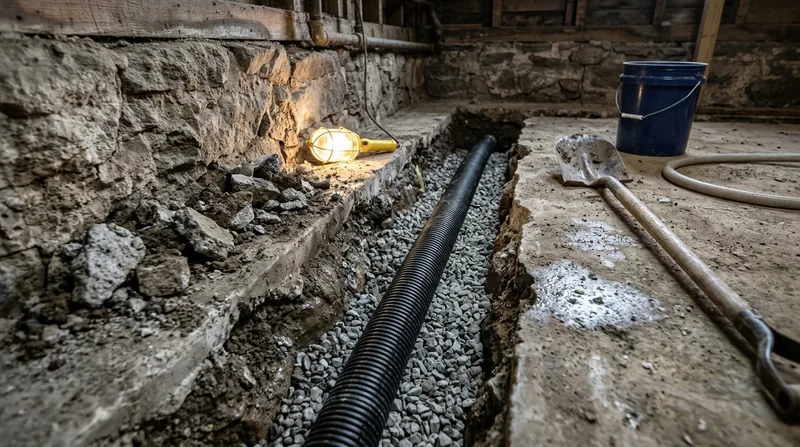




If your basement floor stays wet after every soaking rain or the spring melt, you are not alone. Worcester sits on seven hills of dense glacial till, shallow bedrock ledge and pockets of clay, and the water table climbs fast near Lake Quinsigamond, Indian Lake and the Blackstone and Quinsigamond river valleys. In the 1880s-1920s triple-deckers of Main South and Vernon Hill, the fieldstone and granite rubble walls leak at the cove joint where the wall meets the footing. In the poured and block basements of Tatnuck, Greendale and Burncoat Capes, the same pressure shows up as seepage and efflorescence. An Interior Drain Tile System in Worcester is the proven year-round answer: we cut the slab edge, capture water at the footing and move it to a sump basin before it ever reaches the floor. It is the fix that works when exterior excavation is impractical, and it is the same system we install from Quinsigamond Village to Northborough and Oxford. See how it fits into our full basement waterproofing program.
Why Interior Drain Tile Is the Right Answer for Worcester's Glacial Till and Ledge
Worcester's soil is the real problem. Glacial till and clay hold water against the foundation instead of letting it drain away, and the freeze-thaw cycle that runs from December into March opens cracks and drives meltwater down the grade. Nor'easter rain and snowmelt stack on top of a seasonal high water table, and the result is hydrostatic pressure pushing against the lower walls. When that pressure is the cause, simple crack sealing will not hold, and an interior perimeter drain is the better answer than digging up the outside.
- It captures water at the footing, the lowest point where hydrostatic pressure collects.
- It keeps working year-round, including through the deep freeze when exterior work is not practical.
- It protects the full perimeter, not just the one wall that shows efflorescence or seepage.
- It pairs directly with a sump basin and pump, so water leaves the building instead of pooling.
For a Webster Square triple-decker with a stone rubble wall, that combination is often the difference between a dry floor and a musty basement every spring.
Key info: In Columbus Park and Quinsigamond Village, water often appears at the cove joint days after the rain stops. That delay is the signature of hydrostatic pressure under the footing, not a wall crack, and it is exactly what an interior drain tile system is built to relieve.
Permits and code requirements for drainage work vary by jurisdiction. Always verify the current rules with the Massachusetts Board of Building Regulations and Standards and your local building department before work begins.
How We Install an Interior Drain Tile System in Worcester, Step by Step
Every job starts with a free basement inspection, because the water path has to be confirmed before we cut anything. We check the cove joint, the wall type, the grading, the downspout extensions and the existing sump setup. Then we lay out the drain line so it follows the footing and pitches correctly to the basin. On a 1950s block basement in Tatnuck, that often means a different layout than on a 1990s poured foundation in Westborough.
- We break and remove a strip of slab along the perimeter and dig down to the footing.
- We set the perforated drain tile in washed stone and wrap it in filter fabric to keep glacial clay out.
- We core and set the sump basin at the low point and connect the drain line with the correct pitch.
- We install the sump pump, check valve and discharge line, then test the system with water.
- We backfill, pour new concrete and leave the floor clean and level.
The discharge line has to daylight or tie in correctly, and that connection is where local rules matter most. If the existing drain tile is collapsing, we handle that under drain tile repair and replacement before the new system goes in.
Key info: A recent job on Vernon Hill had a fieldstone wall that wept for two days after each storm. The slab was cut, the footing drain installed and tied to a new sump basin, and the floor has stayed dry through the last two spring melts.
Interior Drain Tile Methods Compared
Not every basement gets the same system. The wall material, the footing depth and whether the floor is poured or slab-on-grade all steer the choice. Here is how the main approaches compare on Worcester housing stock.
| Approach | Description | Best for |
|---|---|---|
| Full perimeter interior drain | Drain tile set at the footing around the entire slab edge, tied to a sump basin | Whole-basement seepage and high water table |
| Partial perimeter drain | Drain line on the wet walls only, with a sump basin at the low point | One or two walls affected, tighter budgets |
| Drain tile plus dimple board | Interior drain combined with a wall membrane that channels seepage down to the tile | Damp stone and rubble walls with efflorescence |
| Drain tile with battery backup | Full system plus a battery backup sump pump for power outages | Finished basements and storm-season reliability |
| Exterior footing drain | Weeping tile and membrane installed from the outside during excavation | Open access, major regrading, or wall repair in progress |
We will tell you plainly when the interior system is the better call and when exterior work makes more sense. For many Worcester lots, the interior route gets the same result without tearing up the yard or the driveway.
Interior Drain Tile System Cost in Worcester: What to Expect
Most homeowners want a number before they commit, and that is fair. Interior drain tile is priced by the linear foot of drain installed, and in the Worcester market the starting point is From $50/linear ft. That figure covers the slab cut, excavation to the footing, the drain tile, washed stone, filter fabric, backfill and new concrete. The sump basin, pump and discharge line are typically quoted as part of the system, not hidden in the per-foot rate.
What moves the price: the length of the perimeter, the wall material (fieldstone and granite rubble are slower to work than poured concrete), whether the floor is poured or a slab-on-grade addition, and how deep the footing sits. Access matters too. A tight basement in a Main South triple-decker takes longer to work than an open 1990s Colonial in Northborough. Ledge near the surface can add time. We recommend getting two or three written estimates on the same scope, and we are happy to walk you through ours line by line. The full pricing overview shows how the line items break down.
What to Look For When Hiring a Waterproofing Contractor Near Worcester
Basement waterproofing is a specialty, not a sideline. Ask whether the company is licensed and insured for drainage and foundation work, and ask for a certificate of insurance before anyone starts cutting slab. Get two or three estimates that describe the same scope, then compare them item by item. Ask for references from jobs in Worcester or the surrounding towns, and ask what happened the following spring. Confirm who pulls any permit the local building department requires, and get the warranty terms in writing. When you are ready, contact us for a free estimate and we will inspect the basement and explain what the water is actually doing.
Interior Drain Tile System Near Me: What Worcester Homeowners Should Know
Searching for an interior drain tile system near me usually means the basement is already wet, and the clock is running. The key is to diagnose the source before quoting a fix. Water at the cove joint after rain points to hydrostatic pressure and an interior drain. Water running down a wall points to grading or downspouts first. Rust streaks and a musty smell point to long-term seepage that needs moisture control before mold growth sets in. We serve Worcester and the surrounding towns, including Westborough and Marlborough, and we will tell you if a simpler repair is enough.
Seasonal Timing: When Worcester Basements Take on Water
Demand here follows the freeze-thaw cycle, not the calendar. The heaviest call volume runs from late February through April, when snowmelt and spring rain stack on top of a high water table and push water through the cove joint. Summer nor'easters bring a second wave, and a sump pump failure in the middle of one is the most urgent call we get. Fall is the smart window for planned work: the ground is still workable, the basement is dry enough to inspect, and the system is in place before the melt. If your basement has a history of spring water, do not wait for the puddle.
Interior Drain Tile System in Worcester: Pricing Guide
| Service | Price | Details |
|---|---|---|
| Full perimeter interior drain tile | Starting at $50/linear ft | Includes slab cut, excavation to footing, perforated tile, washed stone, filter fabric, backfill and new concrete. |
| Partial perimeter drain | Starting at $50/linear ft | Drain line on affected walls only, priced by linear foot, with sump basin quoted separately. |
| Sump basin and pump package | On estimate | Basin, pump, check valve and discharge line priced to the basement layout and discharge route. |
| Battery backup sump pump add-on | On estimate | Added to an existing system, priced by pump capacity and backup runtime needed. |
| Travel | Included | In Worcester and surrounding towns, no separate call-out or mileage fee. |
| Estimate | Free | Free basement inspection and written estimate at (774) 431-8619, no obligation to book. |
Indicative pricing, the exact cost depends on square footage, finish, and site access. Free personalized estimate within 24h at (774) 431-8619.


